Handy to know
Some answers to questions you may have
What types of stone can you install?
I can install any natural or engineered/manufactured stone that comes in loose, split form. Natural stone typically comes in the form of granite, sandstone, limestone and quartzite. Less common is travertine. I have installed all of these stone types. Please click here to see my Stones and Styles page for more information.
What styles can I choose from for the installation?
Stone can be installed either grouted (with grout joints inbetween each piece of stone) or in a dry-stack effect (no grout between stone, each stone is butted up one to another- each stone is still securely fixed with adhesive). You can also choose between natural/random pieces or ledgestone (which is more square and rectangular as standard). Please click here to see my Stones and Styles page for more information.
What is the process of installation?
Whilst a basic outline of the process is featured on the next page, please call and ask about substrate preparation BEFORE beginning substrate installation.
What sets Madano Stone Cladding apart?
At Madano Stone Cladding, safety is paramount. I have gained a lot of knowledge over time, and conducted a lot of research, into safe installation applications. I only use adhesive that not only meets, but considerably EXCEEDS, C2S1 standards, and for especially high-risk work even add special polymer admix to make the adhesive even stronger. I understand substrate movement, and techniques to avoid stone cracking and delamination. Unfortunately, not all installers have the same knowledge, or use the same quality materials, and cracking in stonework and even delamination of stone do happen in practice. As for Madano Stone Cladding, not one stone has failed.
Secondly, regarding aesthetics, not all stonework is created equal. Uneven grout lines and large gaps in dry stack effect work are just some of the mistakes commonplace in stonework today.
You can avoid these issues by insisting on Madano Stone Cladding performing your installs.
I am a stonemason, not a tiler. A stonemason's skill set is better suited for manipulation of loose, random stone pieces, and installing them in a proper, aesthetically pleasing manner. In addition to being a stonemason, I specialise in cladding applications, this is all I do.
What are your prices?
Each job varies quite considerably in terms of complexity. Each job will need to be quoted individually. You can , however, be assured that a quote gives you a FINAL price with no hidden extras, the costs are transparent and fair. Quotes are free and can be performed over phone and e-mail.
Is stone cladding dangerous? What if I want it done internally?
First point: It can be dangerous. If stone is laid improperly, or with poor materials, it can delaminate and fall from the structure. This obviously presents a danger. Stone is also incredibly heavy- a 3mx3m wall will require approximately 750kg of stone to fill.
Fortunately, if you contract competent tradesmen, the installation can be safe and secure. All that is required is a stable substrate, and good quality materials and installation practices. A knowledgable builder and/or engineer will know how to prepare the substrate correctly to handle the heavy load, and an experienced stonemason, like Giuliano from Madano Stone Cladding, will handle the rest.
Where are your areas of service?
Stone Cladding Installation Process
1
The substrate is installed by a builder, ideally in collaboration with an engineer to account for heavy loads to be clad. Typical substrates are masonry and cement sheeting. The substrate and/or framing must be capable of holding approximately 70-90kg/m², depending on the stone chosen. For cement sheeting, this will involve over-engineering beyond manufacturer's specifications.
2
The substrate must be prepared for proper adhesion of stone, and be considerate of potential movement. For masonry this is ordinarily simpler. For cement sheeting substrates, the manufacturer's installation instructions must be followed regarding movement. The substrate must then be primed. For external work, a waterproof membrane must be installed. Internally, a WPM is still recommended as a crack suppresion membrane.
3
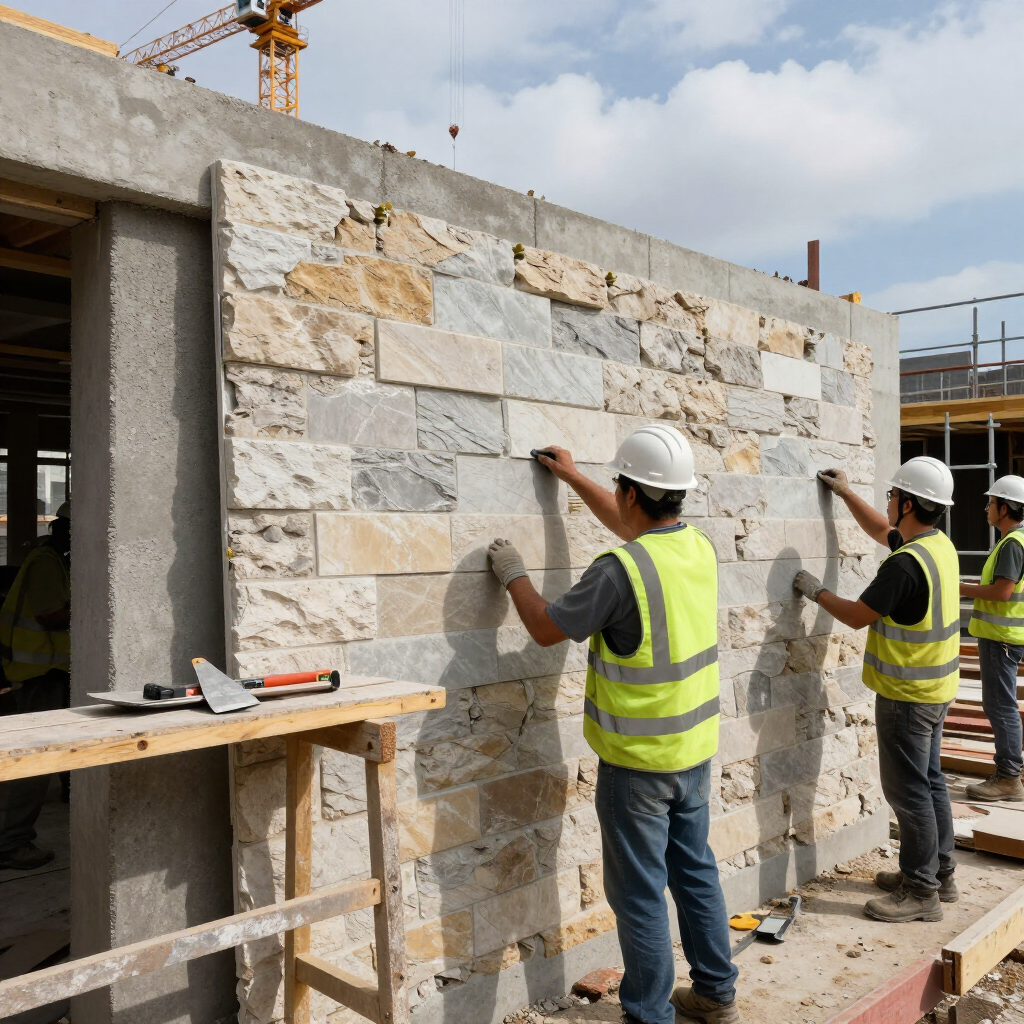
This is the part where I come in. Stone will be carefully installed in relation to movement, and will be installed with care and precision, using only quality materials. Aesthetics and safety are the two maun priorities. The adhesive I use exceeds Australian Standards for C2S1 adhesives. Polymer admix is added to mixes for especially risky or dangerous sections. For grouted jobs, grouting will follow stone installation.
4
A final inspection and clean will follow, with sealant to be applied last (where clients have specified.)
Plan your stone cladding project with clear timelines
Planning and preparation are key for a smooth installation. Involving your stonemason as early as possible ensures that the builder and stonemason are on the same page in terms of timelines, and that the substrate is prepared in a manner suitable and safe for proper adherence and load bearing of the stone.